
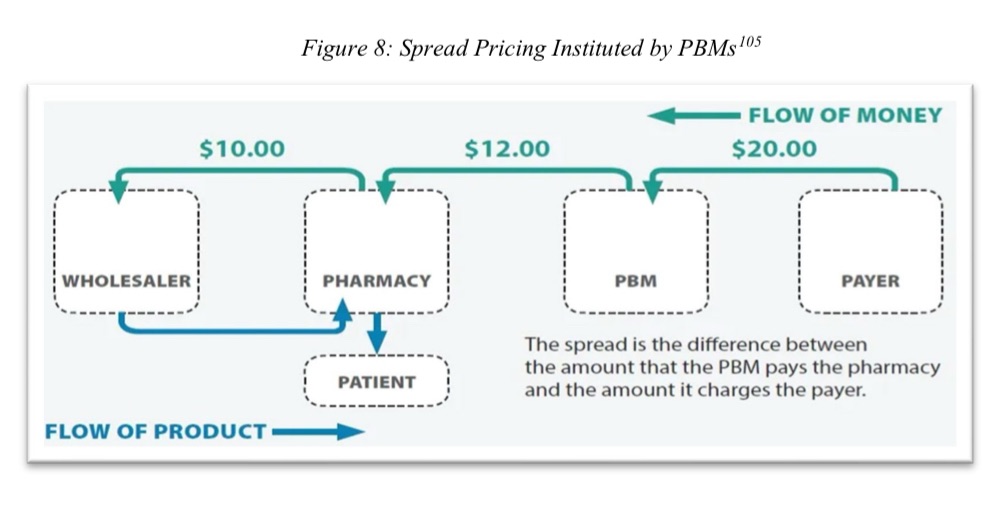
Let’s talk about spread pricing and it’s impact on E=CUP.
What’s spread pricing? It’s a markup.
We understand spread pricing in the physical good world. If you go to a store, you understand that the store paid a lower price for the product than they’re charging you. That spread in the wholesale cost versus the retail costs pays their rent, salaries, benefits, etc.
But there’s another kind of rent-seeking behavior where a spread is not disclosed.
Imagine if you’re a sales rep (and many readers are or were at one point) and you increase all of your mileage submissions by 20%.
By adding a little on top of what you actually incurred as business expenses, you make a little more money.
Sounds like fraud, right? That sales rep would be lucky to leave that situation with only a termination.
What’s the difference? Fairness and understanding. In a retail world, we expect a markup because it’s the cost of doing business. In a reimbursement scenario, we want to reimburse only legitimate expenses – so we require receipts.
Let’s pivot back to healthcare. Spread pricing is being discussed in all fifty states capitols as well as in Washington D.C.
While mostly limited to PBMs and Rx drug payments, the talk has also pointed at TPAs and medical services.
In defense of spread pricing, PBMs like Express Scripts by Evernorth say the model provides more stable pricing to plan sponsors by fixing the cost to the plan regardless of the reimbursement rate. Evernorth also says that transaction details are disclosed and beginning in plan year 2023 (which just ended this past Saturday for 12/1 plans), they will include spread compensation disclosure on their 5500 information.
You can see their explanation here: https://lnkd.in/eFFqrFFF
Evernorth would say that it’s not adding miles to its expense report, but rather it’s charging a mileage allowance for the same number of miles every day, regardless of how far it drives. Some days it drives more, other days it drives less. The cost is predictable, even if not tied to actual expenses.
The image below comes from a House Oversight Committee report on PBM practices and shows “a” model-each transaction is fact-specific. (Available here: https://lnkd.in/eigny8xy).
That report says that the stability offered through spread pricing costs us all a lot. Back to E=CUP – this increases P without improving quality.
So is it insidious rent-seeking more tantamount to expense report fraud, or is it providing stability to plan sponsors?
Unlike vertical and horizontal integration, employers do have some ability to act in regards to spread pricing. While a plan sponsor cannot step into the shoes of the FTC and stop a merger between their two local hospitals, they can contract for transparency with their service providers.
Or can they? What has been your experience in contracting for transparency?
